types of abrasive wheels · grinding wheel types · glass grinding wheels · diamond wheel · resin wheel · glass edge polishing
Types of Abrasive Wheels: Glass Grinding Wheel Types and Selection
For glass processing, use diamond wheels for rough grinding, resin wheels for fine grinding, polishing wheels for final brightness and profile wheels for shaped work.
For glass processing, use diamond wheels for rough grinding, resin wheels for fine grinding, polishing wheels for final brightness and profile wheels for shaped work. Start by confirming the machine, wheel position and application before comparing a replacement wheel or requesting a quote.
Quick answer: which wheel fits each glass process?
Glass processing normally uses a wheel system, rather than one universal abrasive wheel: use diamond wheels for rough grinding, resin-bond wheels for fine grinding, polishing wheels for final brightness, and profile or cup wheels for shaped edges and bevels.
The right wheel depends first on the machine position and process step, then on the glass type, thickness, edge profile, current wheel dimensions and finish requirement. For a dependable replacement recommendation, share the machine model, wheel position and a photo of the existing wheel marking.
The main types of abrasive wheels for glass grinding
1. Diamond grinding wheels: shaping and stock removal
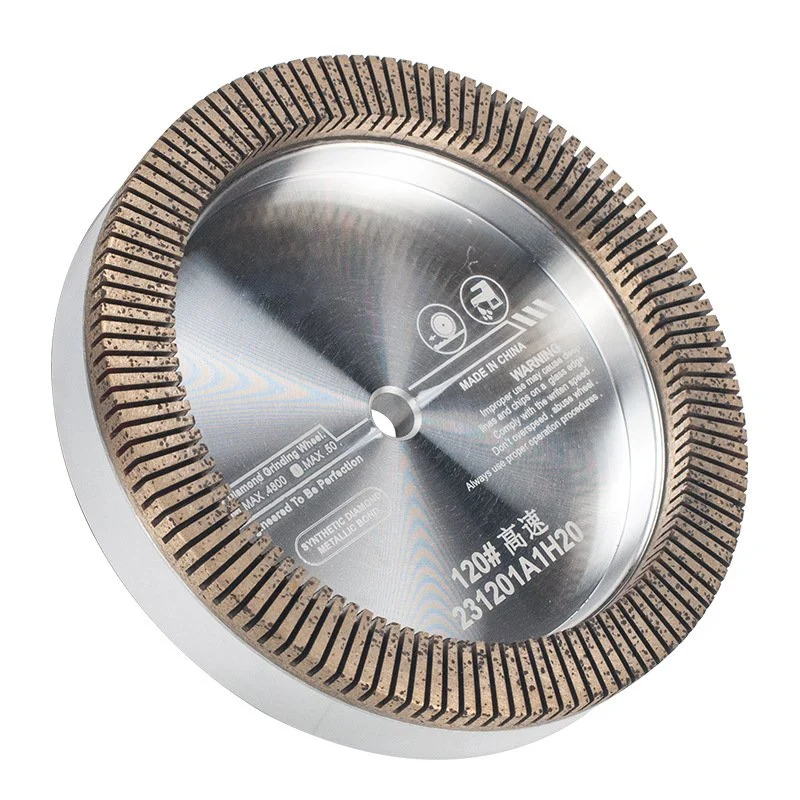
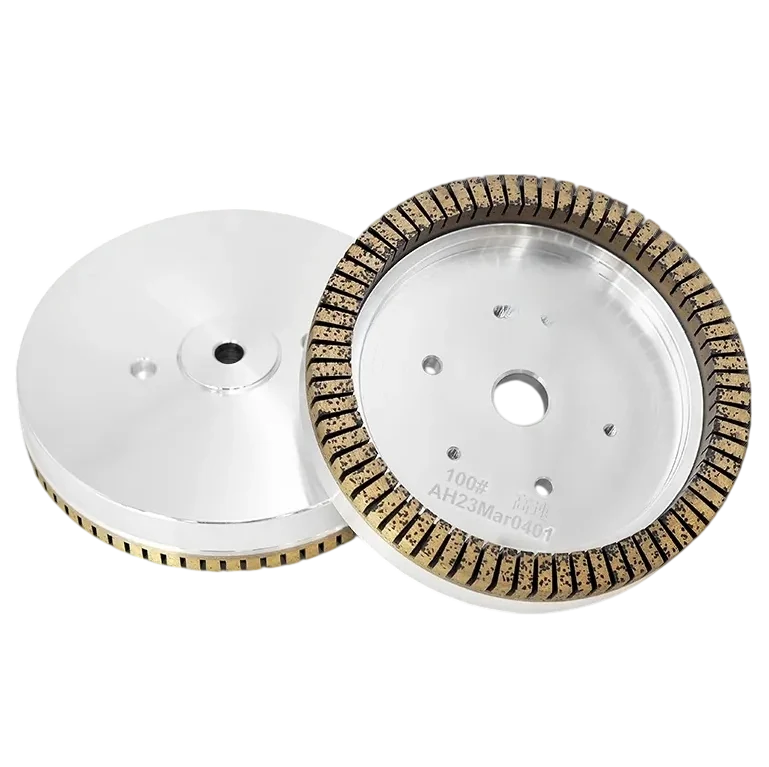
Diamond wheels are the primary cutting tools for glass edge grinding. They are commonly installed in the rough- and fine-grinding positions of straight-line edging, double-edging and beveling machines. Their role is to remove material, form a straight or chamfered edge, and prepare a consistent surface for later refinement.
When specifying a diamond wheel, confirm:
- Machine model and wheel position
- Glass thickness and edge profile
- Outside diameter, thickness and bore
- Wheel profile, working rim and grit
- Coolant condition and spindle speed
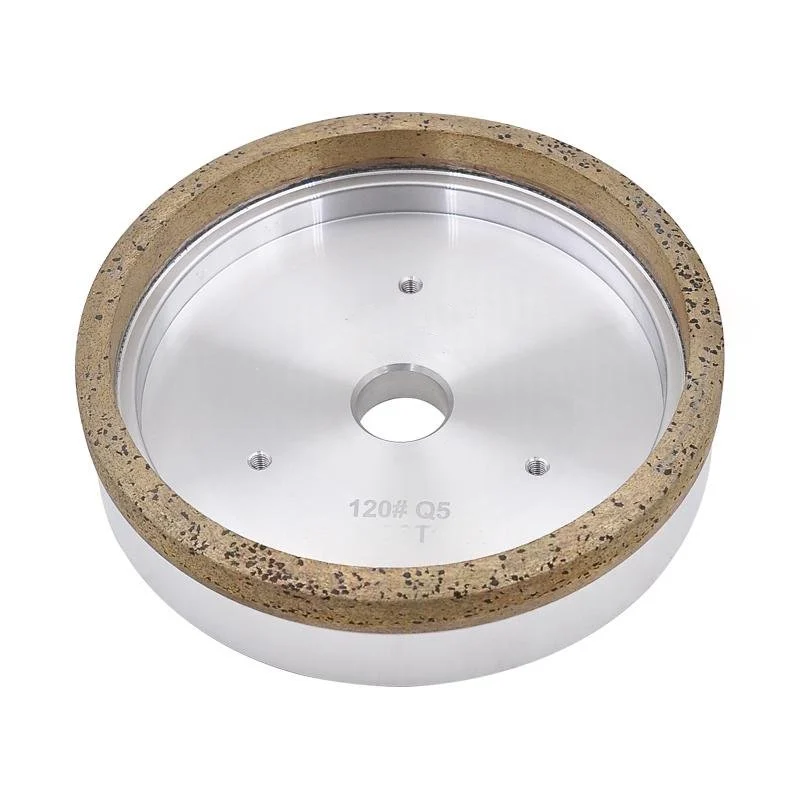
Cup profiles are often selected where the machine needs a stable contact shape for straight or chamfered glass edges. See the glass double-edging wheel sequence and straight-line edging wheel sequence for practical machine-position examples.
2. Resin-bond wheels: fine grinding before polishing
Resin-bond wheels are normally used after diamond wheels. They refine the scratch pattern, improve edge consistency and prepare the glass for final polishing. On many production lines, resin wheels are installed in the R positions between diamond grinding and polishing positions.
Use a resin wheel when the diamond stage has already created the required profile but visible grinding marks must be reduced before polishing. A resin wheel should be selected with the diamond-wheel result, coolant flow and following polishing wheel in mind; it is not a direct substitute for the diamond wheel.
3. Glass polishing wheels: final brightness and mark removal
Polishing wheels are used at the final edge-finishing positions. Depending on the machine and application, they can use rubber-based polishing materials, cerium oxide, wool or other dedicated polishing constructions.
Their job is to remove the light marks left by earlier stages and create a bright, even glass edge. Examples include 10S glass polishing wheels for straight-line and double-edging machines, and cerium-oxide wool polishing wheels for edge, bevel and shaped-glass finishing.
4. Diamond cup wheels: controlled contact for edging and beveling
Diamond cup wheels are a profile family used in glass edge-processing machines where the wheel geometry needs to contact a straight edge, chamfer or bevel in a controlled way. The cup profile, rim width, grit and mounting dimensions must match the machine position.
Do not choose a cup wheel by diameter alone. Two wheels with the same outside diameter can have different rim profiles, bores, working layers and mounting clearances.
5. Segmented and special-purpose wheels
Some glass processes require a specialised wheel construction rather than a standard continuous-rim grinding wheel. Examples include wheels for Low-E coating removal, special profile grinding and machine-specific edge applications. These should be selected from the actual process rather than from a broad product name.
For example, Low-E edge-deletion wheel solutions are designed around removing coating at the glass edge before insulating-glass processing; this is a different task from ordinary edge grinding.
Match the wheel to the glass-processing sequence
| Process stage | Main objective | Typical wheel type | Suitable glass process | Common equipment | Next product link |
|---|---|---|---|---|---|
| Rough grinding | Remove stock and form the edge | Diamond grinding wheel | Straight edges, double edging and initial bevel forming | Straight-line edger, double-edging machine, beveling machine | Diamond wheels for glass |
| Fine grinding | Improve edge geometry and prepare for refinement | Fine-grit diamond wheel | Edge sizing and bevel pre-finishing | Straight-line edger, beveling machine | Glass edge grinding wheels |
| Edge refinement | Reduce diamond-grinding marks | Resin-bond wheel | Fine grinding before polishing | Edger, double-edger and beveling machine | Resin wheels for glass |
| Final polishing | Create a bright, even finish | 10S, cerium-oxide, wool or other polishing wheel | Edge, arris and bevel polishing | Straight-line edger, double-edging machine, beveling machine | Glass polishing wheels |
| Shaped or bevel work | Control contact geometry and bevel profile | Diamond cup or profile wheel, followed by resin and polishing wheels | Chamfers, bevels, arrises and shaped edges | Beveling machine and profile edging machine | Glass edge grinding wheel range |
This sequence is a starting point. The exact layout may vary among straight-line, double-edging and beveling machines. Use the machine drawing and current wheel positions as the authority.
Select wheels by machine and application
Straight-line glass edging machines
Straight-line machines process a continuous glass edge. A common sequence uses diamond wheels for edge shaping, resin wheels for refinement and polishing wheels for the final finish. Start with the straight-line edging machine guide when identifying the D, R and P positions.
Double-edging machines
Double-edging machines process two parallel glass edges at the same time. Wheel selection must preserve stable dimensions and consistent quality across both sides. The double-edging machine guide shows how diamond, resin and polishing stages work together in a typical line.
Glass beveling machines
Beveling wheels need to match both the bevel shape and the finishing sequence. Diamond wheels establish the bevel, resin wheels refine it, and polishing wheels produce the final clarity. Review the glass beveling machine wheel guide before comparing a replacement.
Automotive and specialty glass
Automotive glass grinding may involve specific glass shapes, tolerances and production requirements. Do not rely on a generic wheel description. Provide the machine model, process position, glass type, edge drawing and current wheel specification so the wheel profile and bond can be checked before sampling.
How grit and wheel specification affect the result
Grit is important, but it is only one part of a glass grinding-wheel specification.
- Coarser grit generally supports faster material removal and a more pronounced scratch pattern.
- Finer grit generally supports a more refined edge, but it must be matched to the prior and following wheel stages.
- Wheel profile controls how the wheel contacts the edge, arris or bevel.
- Bond and working layer influence cutting behavior, mark refinement and wheel life.
- Dimensions and bore determine whether the wheel can be mounted safely and accurately.
Changing only the grit may not solve a quality problem. If the edge has chipping, burning, poor brightness, short life or unstable marks, review the full process: machine position, coolant, pressure, wheel condition and the progression from diamond grinding to polishing.
What to send for a wheel recommendation
Send the following details to receive a practical replacement or OEM recommendation:
- Machine brand and model
- Wheel position, such as D1, R2 or P3
- A photo of the current wheel face, side profile and marking
- Outside diameter, thickness, bore and profile drawing if available
- Glass thickness, edge type and required finish
- Current problem: chipping, grinding marks, poor brightness, loading, vibration or short wheel life
The ZHUIFENG product range covers diamond, resin and polishing wheels for glass processing. Use the contact page to send the machine and current-wheel details for specification review.
Key takeaways
The main types of abrasive wheels for glass grinding are diamond wheels, resin-bond wheels and final polishing wheels, with cup and special-purpose profiles selected where the machine process requires them. Choose from the process sequence—not the product name alone—and confirm the machine position, dimensions and required edge result before ordering.
Frequently asked questions
What type of abrasive wheel is used for glass grinding?
Diamond wheels are normally used for glass stock removal and edge shaping. Resin-bond wheels then refine the grinding marks, and polishing wheels provide the final brightness. The exact sequence depends on the machine layout and required edge quality.
What are the main grinding wheel types used for glass edge processing?
The main glass grinding wheel types are diamond wheels for shaping and stock removal, resin-bond wheels for refining grinding marks, and polishing wheels for the final edge finish. Cup and special-purpose profiles are selected when the machine process requires a specific contact shape.
What is the difference between a diamond wheel and a resin wheel for glass?
A diamond wheel performs the main cutting and shaping work. A resin-bond wheel is normally used after diamond grinding to refine the edge and reduce the scratch pattern before polishing. They are complementary process tools, not interchangeable replacements.
How do I select the correct glass grinding wheel?
Confirm the machine model, wheel position, glass thickness, edge profile, wheel diameter, bore, grit and the result you need. A photo of the current wheel and its marking helps verify the specification before production.
Which wheels are used on a double-edging machine?
A typical double-edging machine uses diamond wheels for rough and fine grinding, resin wheels for fine edge refinement, and polishing wheels for the final arris and edge finish. The position sequence varies by machine manufacturer and configuration.